Decking Pedestal Company
Company
Shop By Category
T&Cs
Shop Online
  • Clear materials and product specifications
  • Free tracked delivery across the UK over £30
  • 14-day returns

Adjustable Deck Pedestals 10 Pack 18-30mm | Low Profile Decking Pedestals | Deck Support Blocks

Adjustable Deck Pedestals 18-30mm (10 Pack)

£43.99 £52.99 Save £9
  • 18-30mm Range
  • Ten Per Box
  • Better Drainage
  • Screw And Go

Price: £43.99 £52.99

  • Free tracked delivery across the UK on orders £30+, otherwise a flat £12
  • Pay by card or PayPal, handled by the payment provider
  • 14 days to change your mind, plus your statutory rights
Product specifications
Pack Quantity10 deck support blocks
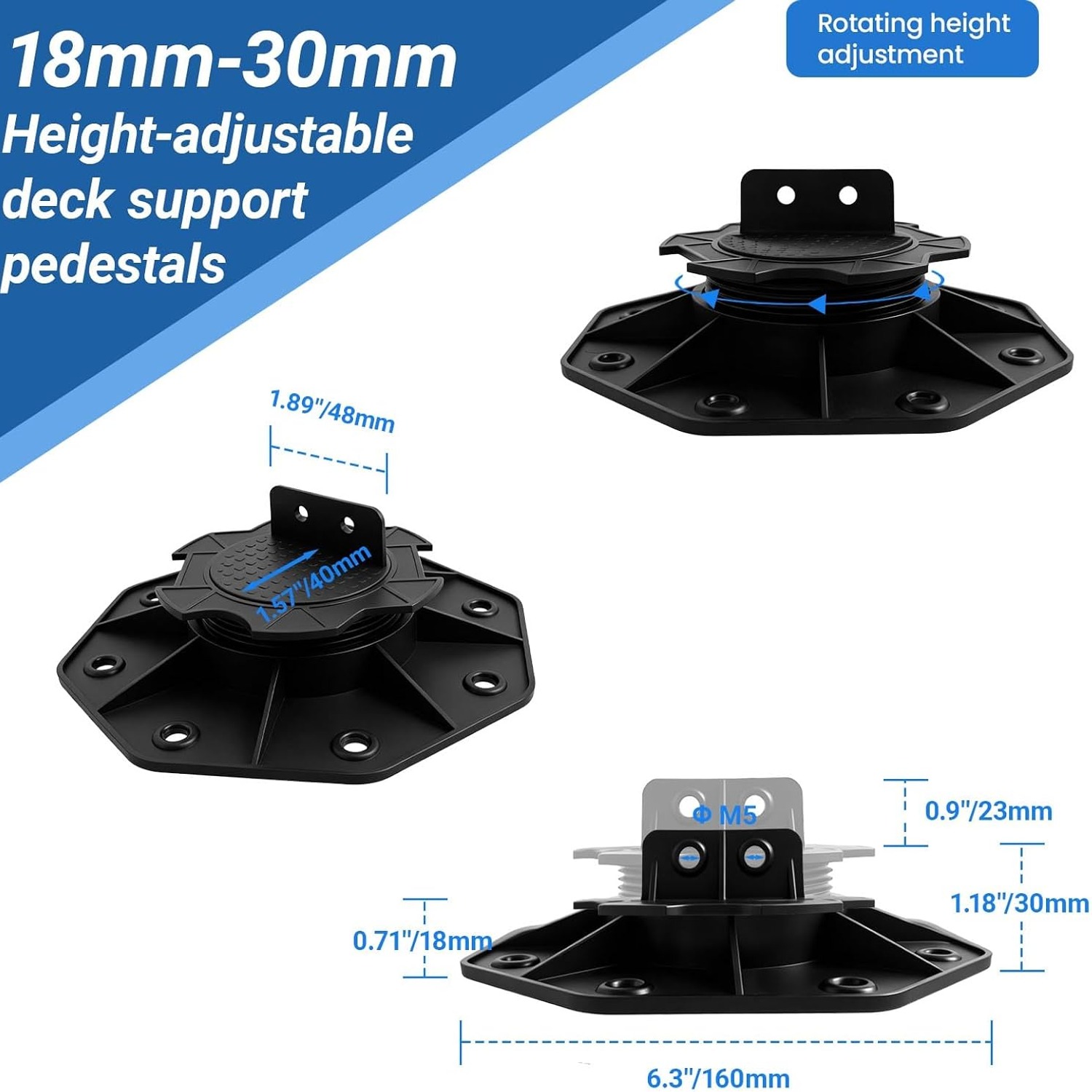
Height Adjustment18mm to 30mm
MaterialHigh-strength PP
ColourBlack
Package Dimensions25 x 25 x 22.2 cm
Weight720 g
Included Components10 x deck blocks (18mm-30mm)
Batteries RequiredNo
Country of OriginChina
Weight720 g
Shipping & returns

Tracked delivery anywhere in the UK. It is free on orders of £30 or more, and a flat £12 below that.

Under the Consumer Contracts Regulations 2013 you have 14 days from delivery to cancel for any reason, and a further 14 days to send it back in resaleable condition. We refund the price you paid, including standard delivery. You cover the cost of returning it unless the item is faulty.

If it arrives faulty, damaged or not as described, we put it right at no cost to you under the Consumer Rights Act 2015, return postage included.

Shipping details · Refunds and returns

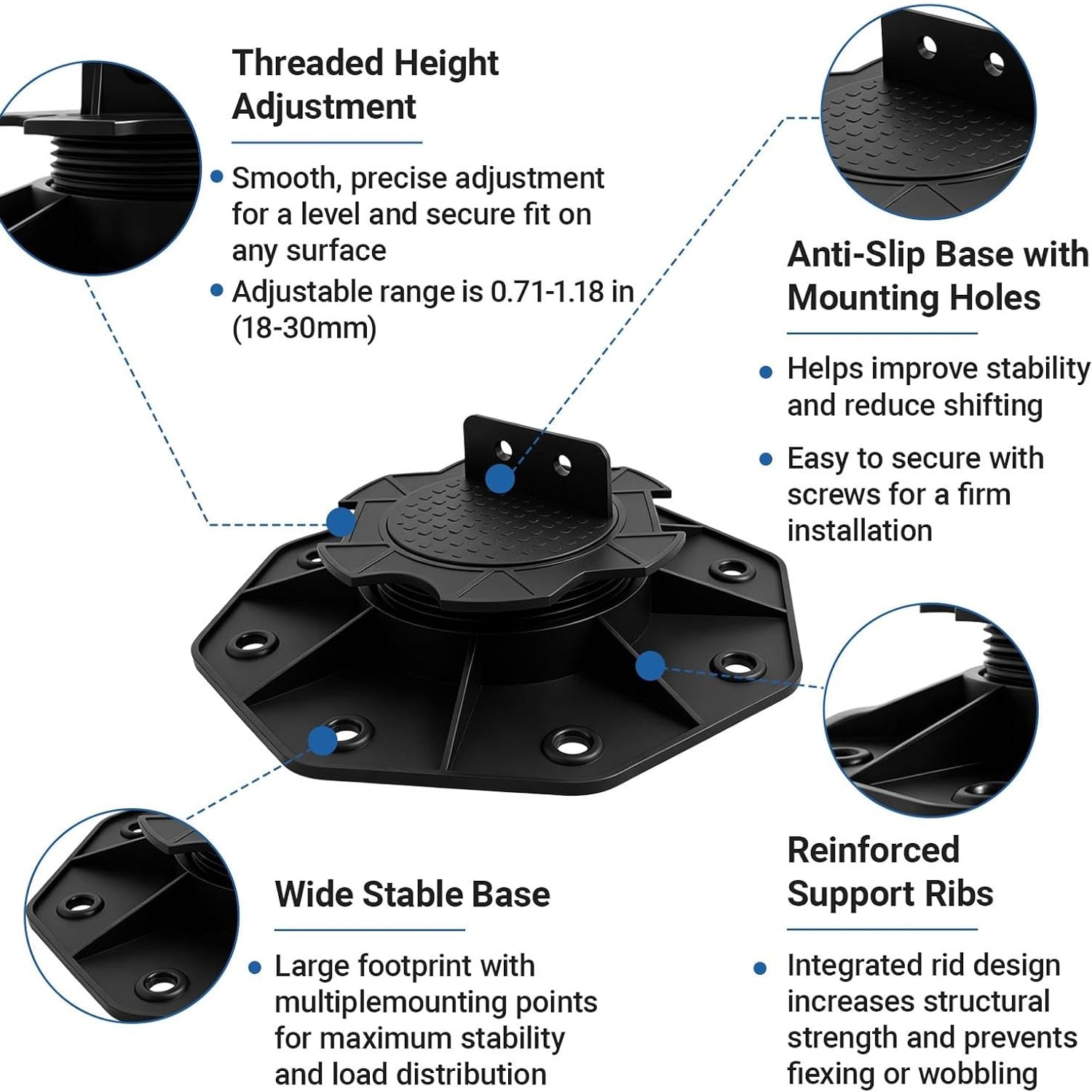
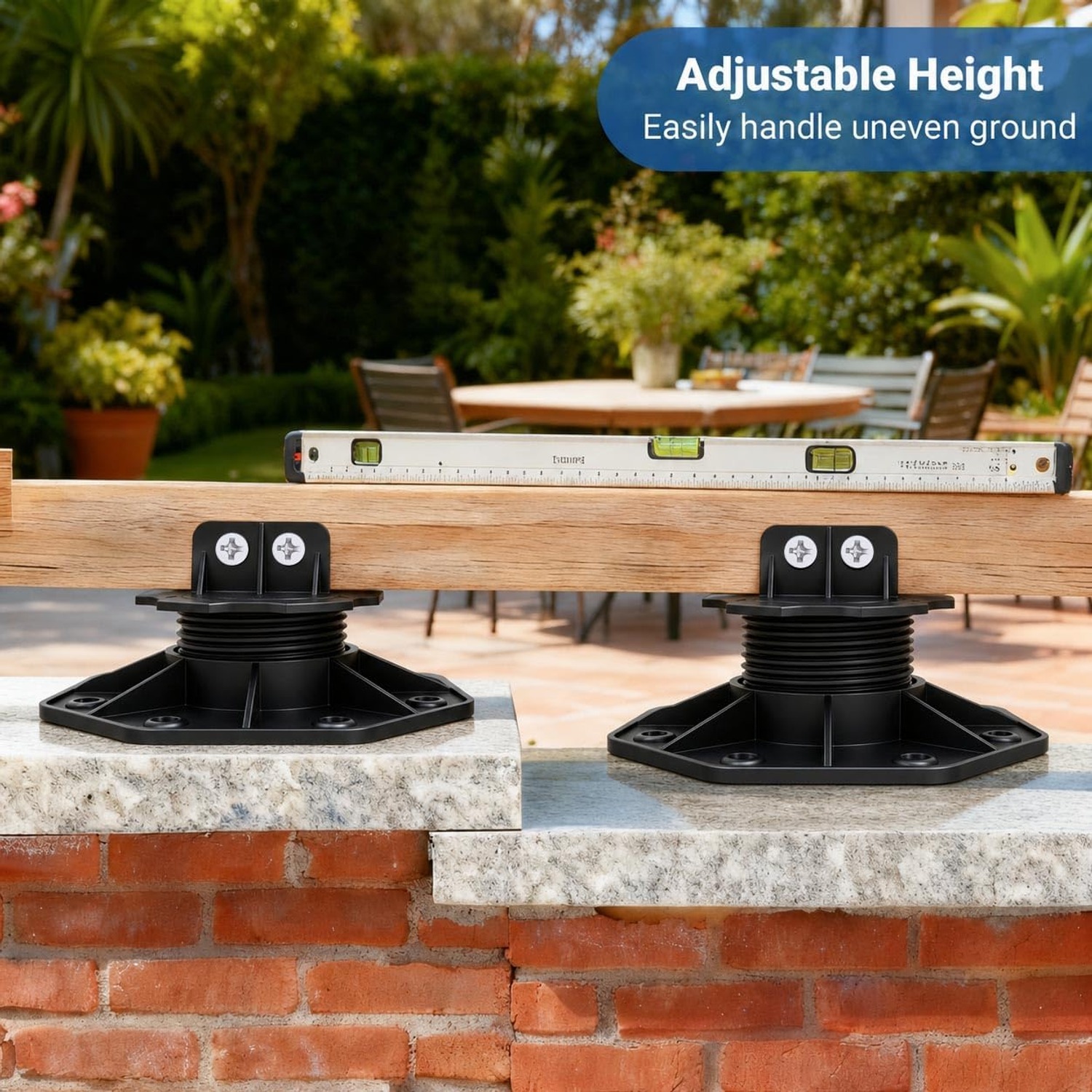
18-30mm RangeDial each support to suit dips and high spots in the ground.
Ten Per BoxEnough supports to grid out a small deck, landing or shed floor.
Better DrainageLifts timber off the slab so rain runs away instead of sitting.
Screw And GoFixes through the top plate into the joist with ordinary screws.

Get a flat, quiet, well-drained floor underfoot with adjustable decking pedestals that take the guesswork out of levelling a low deck with deck support blocks.

Each pedestal screws straight to your joist and dials between 18mm and 30mm, so you can correct dips, lift timber clear of damp ground and keep water moving instead of pooling.

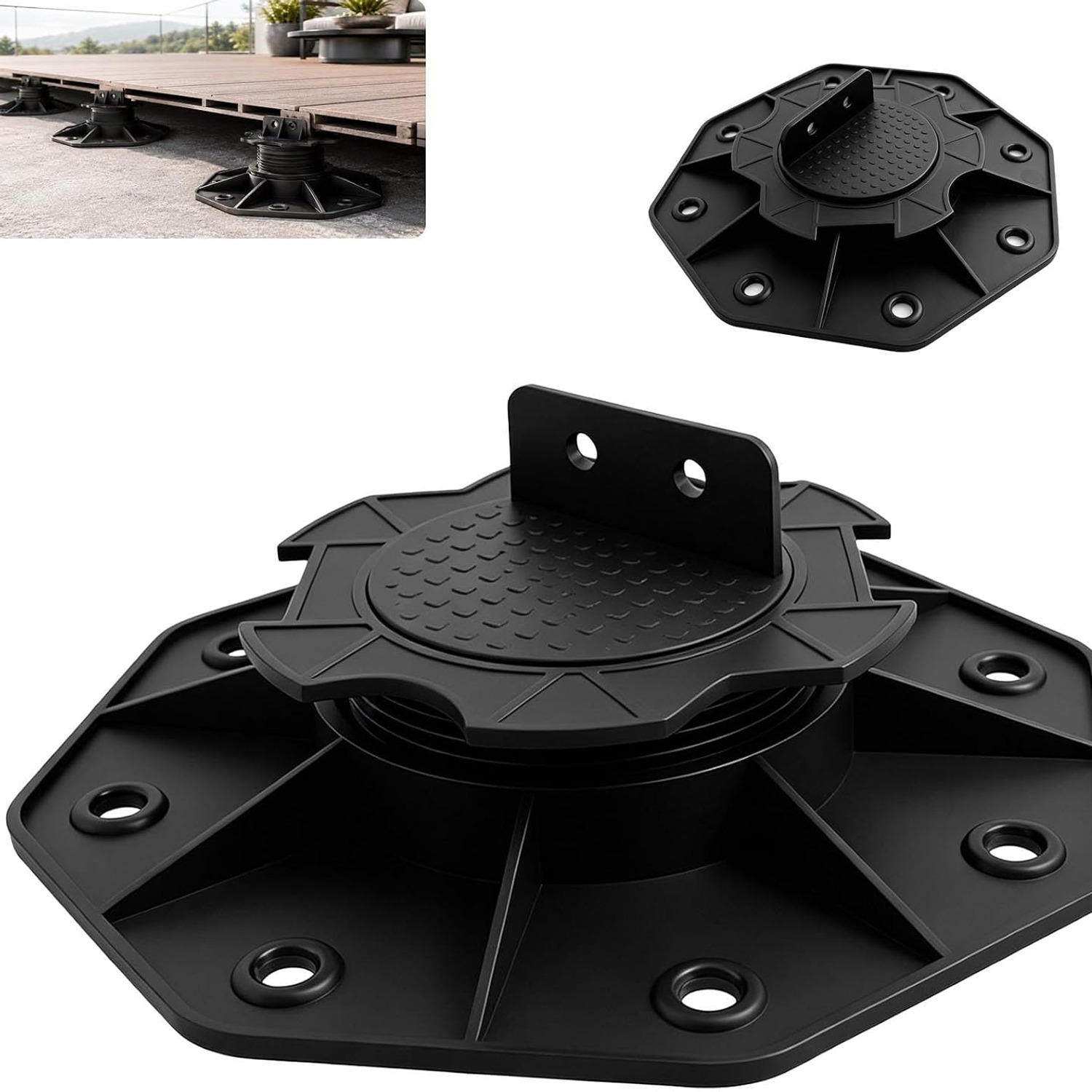
Ten adjustable deck pedestals that let you set each support point between 18mm and 30mm for a flat, even floor.

Made from high-strength PP, a plastic chosen for its resistance to corrosion and oxidation in outdoor conditions.

The rounded base spreads the load and helps stop the deck rocking, swaying or tilting underfoot.

Installation is simple, with screws passing through the holes in the upper plate and into the joist.

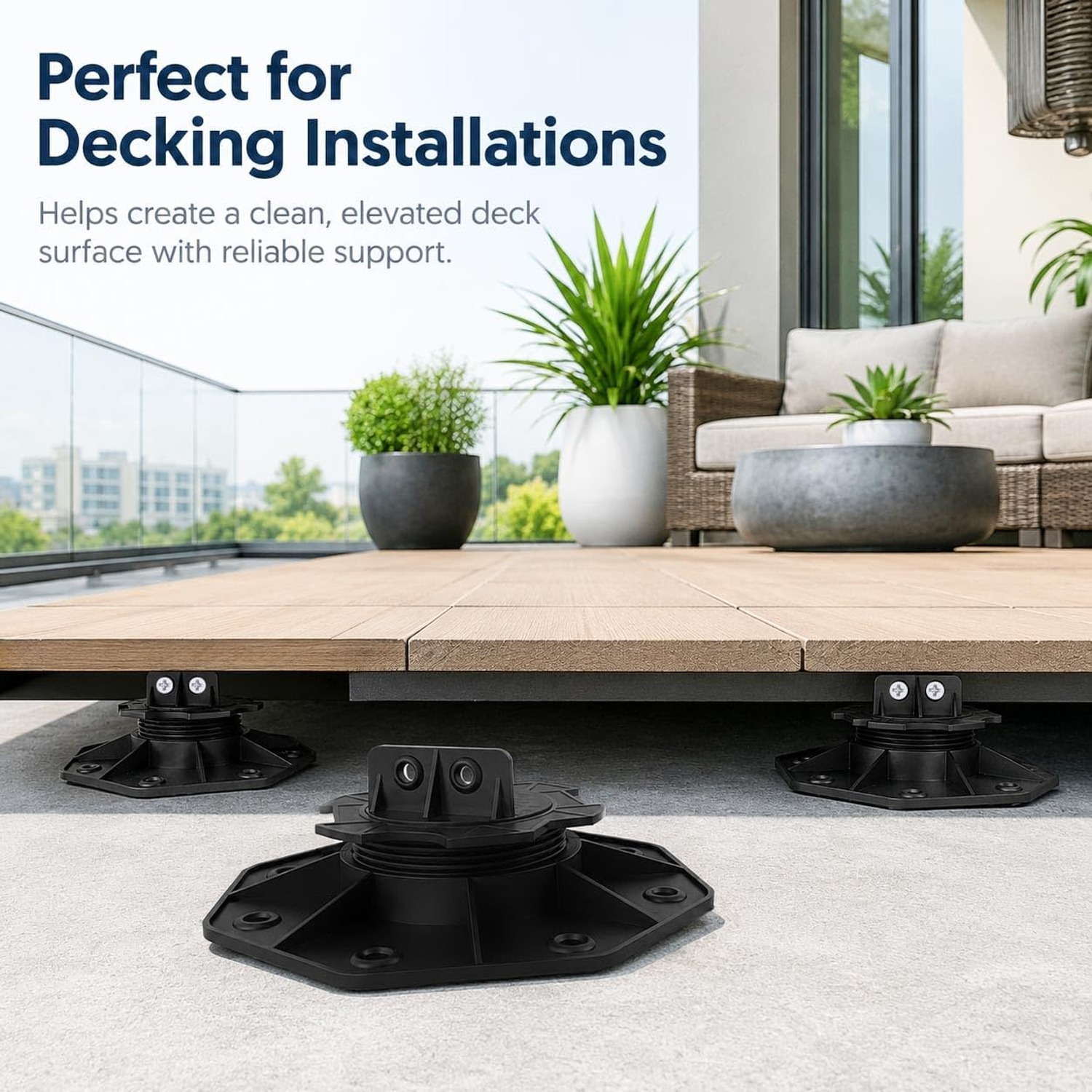
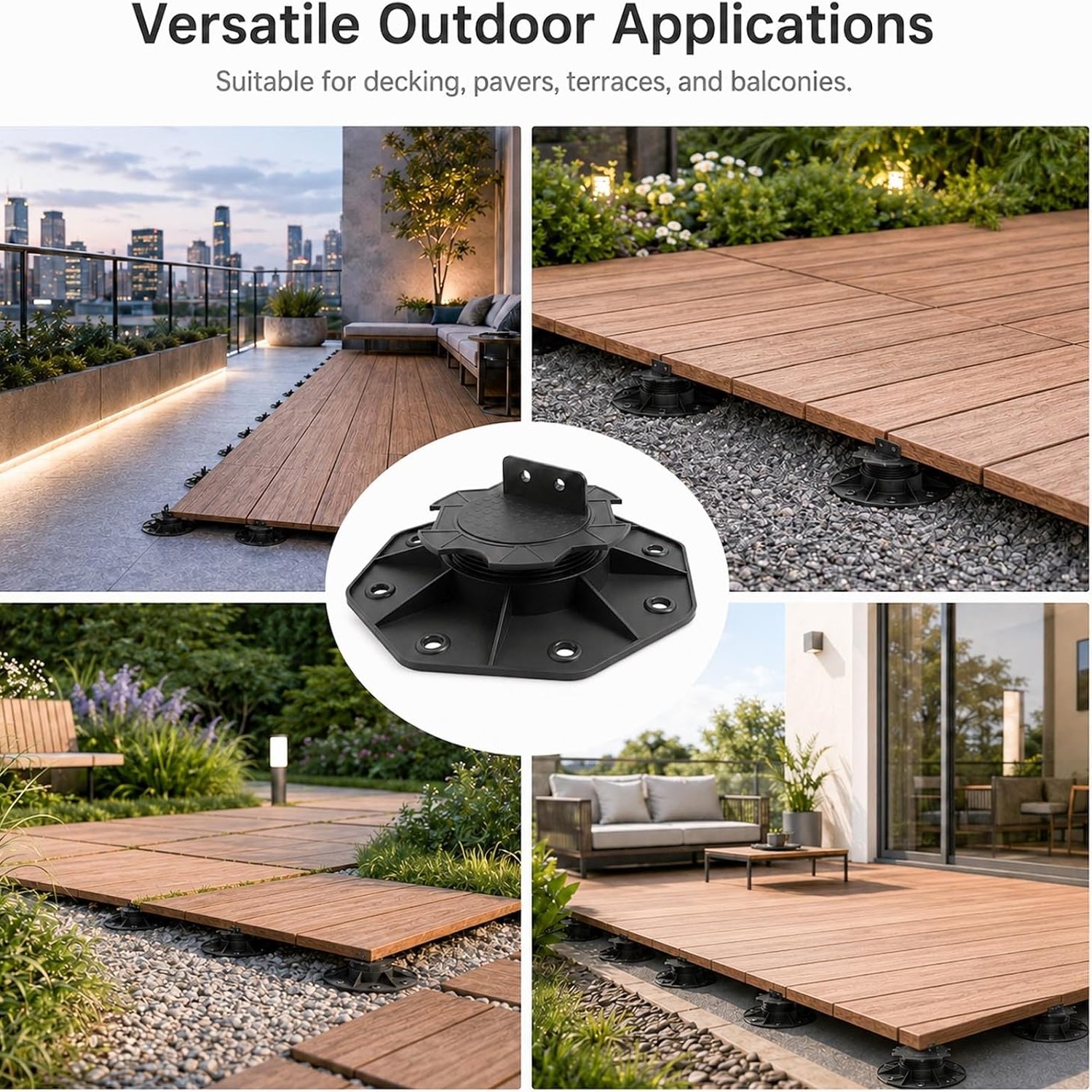
Suits outdoor decks, patios, multi-level decks, walkways and sheds, and works with treated timber, WPC joists, stone and mesh flooring.

Adjustable Deck Pedestals 18-30mm (10 Pack)

A low deck looks simple until you start building one. The ground is never as flat as it looks, concrete slabs run off to a drain, and pavers settle at their own pace. Packing timber with offcuts and shims is the usual fix, and it is the usual reason a deck starts to creak and rock a year later. These adjustable deck pedestals replace all that fiddling with a support you can dial to the exact height you need, anywhere between 18mm and 30mm.

Adjustable Deck Pedestals 18-30mm (10 Pack)

Each pedestal is moulded from high-strength PP. That material was picked for a reason, as it resists corrosion and oxidation, which matters when a support spends its whole life in sun, rain and frost. The maker states it will not easily deform, age or crack under long exposure to those conditions. Unlike timber packers it has nothing in it for termites to eat, and unlike steel there is nothing to rust out from under your joists.

Adjustable Deck Pedestals 18-30mm (10 Pack)

The base is rounded, a shape that helps spread weight into the surface below and keeps the whole structure stable. That is what stops a low deck from feeling springy at the edges. Because the height can still be adjusted after the deck is built, you are not locked in. If the ground settles over a wet winter and one corner drops, you can get underneath, change the setting and bring the floor back to level rather than pulling boards up.

Adjustable Deck Pedestals 18-30mm (10 Pack)

Fitting them is about as plain as it gets. Pass screws through the small holes in the upper plate and drive them into the joist. There is no mixing, no curing and no waiting a day before you can carry on. The maker notes that no ongoing maintenance is required during use, and that the high-strength material will not rust or crack, which saves on replacing supports down the track.

Adjustable Deck Pedestals 18-30mm (10 Pack)

The pack of ten suits a decent range of jobs. People use these for outdoor decks, patios, multi-level decks, walkways and sheds. They are compatible with outdoor treated timber, WPC flooring joists, various types of stone, engineered mesh flooring, greenhouse flooring and pipework, and they are offered as an alternative to traditional concrete piers and wooden posts. Lifting the deck slightly also opens up a shallow space underneath for drainage and a little storage.

Not sure yet? That is fine.

Fibre, weight and colour are hard to judge from a photograph, and a piece has to feel right in the hand. Under the Consumer Contracts Regulations 2013 you have 14 days from delivery to cancel for any reason, and a further 14 days to send it back in resaleable condition. We refund the price you paid, including standard delivery.

If it turns up faulty, damaged or not as described, that is on us. The Consumer Rights Act 2015 covers you, and we pay the return postage. Read the full detail on our refunds and returns page, or ask us anything before you order.

Frequently Asked Questions

What exactly is in the pack?

You get ten deck support blocks, each adjustable between 18mm and 30mm. The listed included components are 10 x deck blocks (18mm-30mm). No screws or fixings are listed as included, so plan on supplying your own.

How much height can each pedestal give me?

The adjustment range is 18mm to 30mm, which is roughly 0.7 to 1.2 inches. That is a low-profile range designed for decks sitting close to a slab or firm ground. If you need to lift a deck well above the ground, these are not the right support.

What are they made from?

They are moulded from high-strength PP. The maker points to its corrosion resistance and oxidation resistance, and states it holds up to sun, rain and frost without easily deforming, ageing or cracking.

How much weight can one pedestal hold?

No load rating in kilograms is given for this product, so we will not quote one. The maker describes the base as having high load-bearing capacity and a rounded bottom design that adds to it, and says the structure resists breakage and bending. For any structural deck, check your local building rules and a builder's advice on spacing.

Are these the right low profile decking pedestals for a slab?

They are built for exactly that job, where a slab or paved area is close to the finished floor height you want. The 18-30mm range lets you follow the fall of a slab while keeping the deck surface flat. For greater heights you would want a taller pedestal system.

How do I install them?

Set each pedestal under a joist at the height you need, then drive screws through the small holes in the upper plate into the joist. That fixing holds the support in place and keeps the structure stable. Work across the deck checking level as you go.

Can I adjust the height after the deck is finished?

Yes. The maker specifically notes that adjustments can be made after installation, which is useful if the ground settles. You will need access to the support, so it is easier on an open-sided low deck than on a fully boxed-in one.

How far apart should I space them?

Spacing depends on joist size, board thickness and the load you expect, so follow the span tables and local rules for your deck. As a rough starting point, many low decks run supports every 400mm to 600mm along each joist. Closer spacing gives a firmer floor.

Will ten be enough for my deck?

Ten supports typically cover a small landing, a step platform or part of a joist run. For a full deck most people buy several packs. Sketch your joist layout, mark the support points, then count them before ordering.

Can I use these under pavers or stone?

The listed compatible surfaces include various types of stone as well as engineered mesh flooring. They are offered as an alternative to traditional concrete piers. For heavy stone, check the weight involved and increase the number of supports accordingly.

Do they work with composite decking?

Yes, they are listed as compatible with WPC flooring joists as well as outdoor treated timber. The pedestal supports the joist, so the board material above matters less than the frame below. Composite framing often likes closer support spacing, so check the board maker's guide.

Are they suitable for a shed floor?

Sheds are one of the listed applications. Lifting a shed floor slightly off a slab helps keep moisture from sitting against the timber bearers. These are often picked as shed floor supports for small garden sheds on firm ground.

Will they stop my deck from rocking?

That is the point of the rounded base design, which the maker says improves stability and helps prevent the deck swaying and tilting. Rocking usually comes from uneven support heights, so dialling each one in properly matters as much as the hardware. Check level at every point before you fix the boards.

Do they help with drainage?

Yes. Raising the deck slightly off the ground lets water run underneath rather than pooling against timber. The maker notes this helps prevent deck moisture and corrosion while optimising drainage.

Can I use them on grass or soil?

They are designed to sit on a firm, stable surface. On soft ground you would want a solid pad, paver or compacted base under each pedestal so it does not sink. Settlement is the main enemy of a level deck.

What colour are they?

Black, which disappears into the shadow under a deck. That makes them far less noticeable than pale timber packers when you look at the deck edge from the garden.

Will they rot or attract termites?

They are plastic, not timber, so there is nothing in them for termites to eat and nothing to rot. The maker also states they will not rust or crack during use. That is a key reason people choose them over wooden packers in warmer, wetter regions.

Do they need any maintenance?

The maker says no maintenance is required during use. In practice, keeping leaves and soil clear from around the bases helps drainage, and a quick check of the fixing screws after the first season is sensible.

Can I cut or trim them?

We would not recommend it. Cutting a moulded support changes how it carries load and may compromise the adjustment mechanism. If the height range does not suit your job, choose a different pedestal size instead.

What is the difference between these and concrete piers?

Concrete piers are fixed height, heavy to handle and need to be set accurately before you build. These adjust after the fact, weigh very little and screw straight to a joist. For low decks on an existing hard surface, many people find adjustable deck levelling feet far quicker to work with.

Are they UV stable?

The maker describes the PP material as resistant to oxidation and states that long exposure to sunlight, rain and frost does not easily cause deformation, ageing or cracking. Most of a pedestal sits in shade under the deck anyway, which helps.

What is the product weight?

The listed item weight is 720 g, and the package measures 25 x 25 x 22.2 cm. That is the pack figure given in the product details. It makes them easy to carry around a site compared with concrete.

Can I use them indoors?

Nothing about the design prevents indoor use under a raised subfloor or platform, and greenhouse flooring is a listed application. Just make sure the surface below is solid and that any indoor structural work meets local rules.

Can they be reused if I pull the deck up?

Generally yes, since they are screwed rather than glued or cast in place. Remove the fixings, clean off any grit, and check each one for damage before reusing. That reusability is part of the appeal over concrete.

Do I need special tools?

A drill or driver for the screws, a spirit level or string line, and a tape measure cover most of it. There is no mixing, curing or heavy lifting involved. Most people find the installation straightforward with basic DIY tools.

Will they work on a sloping slab?

That is a common use. The adjustment lets you take up the fall across a slab so the finished deck surface comes out flat. Just check the total fall first, because anything beyond the 12mm of adjustment range will need shimming or a different support.

How do I keep track of the heights while building?

Run a string line or use a long straightedge and level across the deck area, then set each pedestal to touch it. Working from one reference line rather than measuring each spot off the ground gives a much flatter result.

Are these a good gift for a keen DIYer?

They make a practical gift for someone planning a deck, a garden platform or a shed floor. A pack of ten is a useful starter quantity rather than a token. Pair them with a decent spirit line or driver bit set if you want to round it out.

How is this item delivered?

It ships as a boxed pack from our fulfilment partner to your delivery address. You will get tracking details once the parcel is on its way. Delivery timing depends on your location, and checkout will show the options available to you.

What if they are not right for my project?

If the height range does not match your build or the pack is not what you expected, contact us and we will walk you through the return process. Keep the packaging and leave the supports unfitted where possible, as unused goods are simplest to return. Tell us what you are building and we can point you to a better-suited support height.

How To Choose Adjustable Deck Pedestals For A Low Deck

6 min read Decking Pedestal Company

The problem with building low

Every low deck starts the same way. You stand on the slab or the paved area, you lay a straightedge across it, and you find out the ground is not flat. It never is. Slabs are poured with a fall so water runs off. Paved areas settle. Compacted gravel moves a few millimetres here and there over a wet season. None of that is a fault, it is just how outdoor surfaces behave.

Then you have to build a flat timber floor on top of it.

The old answer is packers. Offcuts of treated pine, scraps of hardwood, a bit of plastic from the shed, whatever is lying around. They work on day one. The trouble shows up later. Timber packers absorb water, compress and rot. Thin ones split under load. And because each one is a different thickness, you end up with a floor that is level in some spots and a whisker out in others. That whisker is what you feel when a board flexes under your heel and the deck lets out a creak.

Adjustable deck pedestals exist to get rid of the packer pile. Instead of hunting for a 23mm offcut, you set the support to 23mm and move on.

What these ones do

This pack holds ten deck support blocks, each one adjustable between 18mm and 30mm. That is a narrow, deliberate range. It is aimed squarely at decks sitting close to an existing hard surface, where you need to take up the fall on a slab, bridge a settled paver or simply lift the frame off the ground so water can get away.

The body is moulded from high-strength PP. The maker chose it for corrosion and oxidation resistance, and states it does not easily deform, age or crack after long exposure to sun, rain and frost. For anyone building in a hot, wet climate, that matters more than it sounds. A support that spends ten summers baking and ten winters soaking has to hold its shape or the whole floor shifts with it.

Underneath, the base is rounded. That shape helps push the load down into the surface below instead of concentrating it on a corner, and it is part of why the maker describes the structure as resistant to breakage and bending. In plain terms, it is what keeps the deck from feeling springy or rocking under your weight.

The top plate has small holes in it. Screws go through those holes and into the joist, which locks the support to the frame. That is the whole fixing method. No concrete, no curing, no coming back tomorrow.

Who they suit

They suit anyone building low and building on something firm. Decks over a concrete slab. A landing outside a back door. A walkway through a garden. The floor of a garden shed sitting on a pad. A multi-level deck where one tier only needs to rise slightly above the next. Greenhouse flooring, where keeping timber out of constant damp is half the battle.

The listed compatible materials cover a wide spread: outdoor treated timber, WPC flooring joists, various types of stone, engineered mesh flooring, greenhouse flooring and pipework. If you are hunting for adjustable decking feet for a composite frame, the WPC compatibility is worth noting, because composite joists are often fussier about support than timber.

They do not suit a deck that needs to sit well above the ground. Thirty millimetres is the ceiling here. If you are building over sloping garden ground, or you want a usable space underneath, you need a taller pedestal system or a proper pier and post structure.

They also do not suit soft ground on their own. Set a pedestal straight onto loose soil and it will find its own level over the first wet month, usually a few millimetres lower than where you left it. Put a paver or a compacted pad under each one and the problem goes away.

Working out how many you need

This is where most people get caught out. Ten sounds like a lot until you draw the layout.

Support spacing depends on joist size, board thickness, board direction and the load you expect the deck to carry. Follow the span tables that apply where you live, and check local building rules before you commit. As a rough feel, a lot of low decks place a support every 400mm to 600mm along each joist, and closer where boards cantilever at an edge or where a step lands.

Do the maths on paper first. Draw the deck to scale, mark the joists, then mark a dot at every support point. Count the dots. That number, rounded up, is how many pedestals you need. A small landing might take eight. A three by four metre deck will take several packs.

It is cheaper to order one pack too many than to stop work halfway and wait for a delivery.

Getting the install right

The fitting is simple, but the setting out is what decides whether the deck feels solid.

Start with a reference. Run a tight string line, or lay a long straightedge with a level on it, across the full area at your finished frame height. Everything else gets measured off that one line, not off the ground. Measuring each spot from the slab is the fastest way to end up with a wavy floor, because the slab is the thing you are correcting for.

Set each pedestal to touch the line, then fix the screws through the top plate into the joist. Work in a sequence rather than jumping around, so you always have a fixed reference beside you. Check with the level often.

One genuinely useful feature here is that the height can still be changed after installation. If a corner settles over the first wet season, you can get underneath, back the screws off, re-dial that support and bring the floor back to flat. On a deck sitting on concrete piers, that kind of correction means pulling boards.

Looking after them

There is very little to do. The maker states no maintenance is required during use and the material will not rust or crack.

In practice, two small habits help. First, keep the space under the deck clear. Leaves, soil and grit pack in around the bases over time and block the drainage path you built the deck to have in the first place. A hose or a leaf blower once or twice a year sorts it. Second, check the fixing screws after the first season. Timber moves as it dries out, and a screw that was tight in autumn can be a little loose by the following spring.

No oil, no paint, no sealer. Plastic supports in shade are about the lowest-maintenance part of any deck.

How they compare

Against concrete piers, the trade is adjustability and weight against raw mass. Piers are fixed once set and heavy to move, but they carry very large loads. Pedestals adjust, weigh almost nothing and fit in a shopping bag. For low work on an existing hard surface, most people find the pedestal faster by a wide margin.

Against timber packers, there is not much of a contest outdoors. Packers rot, compress and feed termites. These do none of those things.

Against taller pedestal systems, it comes down to height. If your range is 18mm to 30mm, this pack is cheaper and simpler. If you need 80mm, buy the taller one.

The short version

If you are building low on a slab, a paved area or a firm compacted pad, and you need to take up a small amount of fall to get a flat floor, this is the right kind of hardware. Ten supports, each dialling from 18mm to 30mm, screwed through the top plate into your joists. PP body chosen for weather resistance, rounded base for stability, adjustable again later if the ground moves.

Draw your layout, count your support points, order enough, and set everything off one string line. Do that and the deck will feel solid the day you finish it and still feel solid five years on.

Browse the shop

Not sure how many you need?

Sketch your joist layout, mark a support point every 400mm to 600mm, and count the dots before you order.

Ask us a question

Page summary

Adjustable deck pedestals sold as a pack of ten, made by Trituke under part number GHB-89H6. Each support adjusts in height from 18mm to 30mm and is moulded from high-strength PP, a material the maker describes as resistant to corrosion and oxidation and unlikely to deform, age or crack outdoors. The base is rounded to help spread load and limit deck sway. Fitting is by screws through holes in the upper plate into the joist, and height can be readjusted after installation if the ground settles. Listed uses include decks, patios, multi-level decks, walkways and sheds, with treated timber, WPC joists, stone and mesh flooring. Colour is black, pack weight 720 g. No load rating is specified in this record.